04 // Structures, Biomedical & Leadership
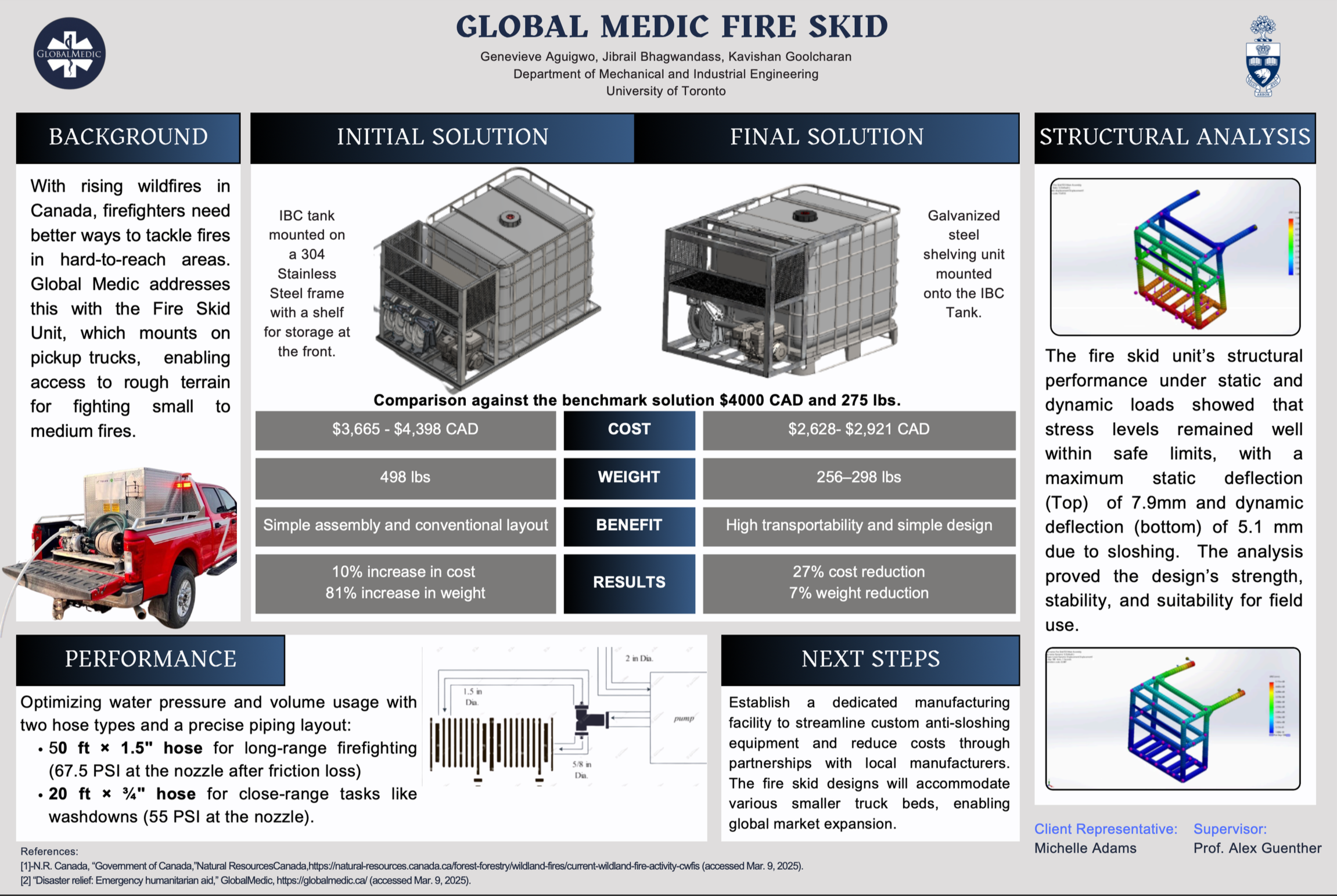
Global Medic's Fire Skid — Mechanical Redesign
U of T Community Partner Project · 2023
Global Medic is a Canadian humanitarian NGO delivering emergency response equipment to disaster-affected communities worldwide. This project was part of U of T's community-partner capstone program.
This project tasked our team with redesigning a portable fire-suppression system for mounting on pickup trucks — to be deployed by Global Medic in disaster relief zones where conventional fire vehicles cannot reach. The existing system was overweight, structurally inefficient, and difficult to mount safely on diverse vehicle platforms.
Our engineering challenge was two-fold: reduce mass to expand the range of compatible vehicles, while maintaining full pressure-vessel safety margins for a system carrying pressurized firefighting agent over rough off-road terrain.
The critical load case for this system was dynamic shock loading during off-road transport — potholes, corrugations, and abrupt terrain changes generate acceleration spikes well beyond static weight. We extracted representative acceleration profiles from published off-road vehicle data and applied these as inertial loads in ANSYS Mechanical.
The pressure vessel itself was analyzed under combined mechanical load (transport shock) and internal pressure, ensuring von Mises stress remained below the material's yield strength with an appropriate safety factor. Material substitution — replacing heavier steel components with aluminum alloy where pressure and structural requirements allowed — drove the mass reduction without compromising safety.